Practical guide
Brand the products you already own: UV DTF, direct UV or laser?
Choose a branding method for your own products in the UAE. Compare surfaces, samples and scope, including customer-supplied items for UV flatbed and laser marking.
If you already own flasks, notebooks, boxes or other products, start with the item—not the printing name. Its surface, coating, shape and intended use decide which branding method is worth sampling.
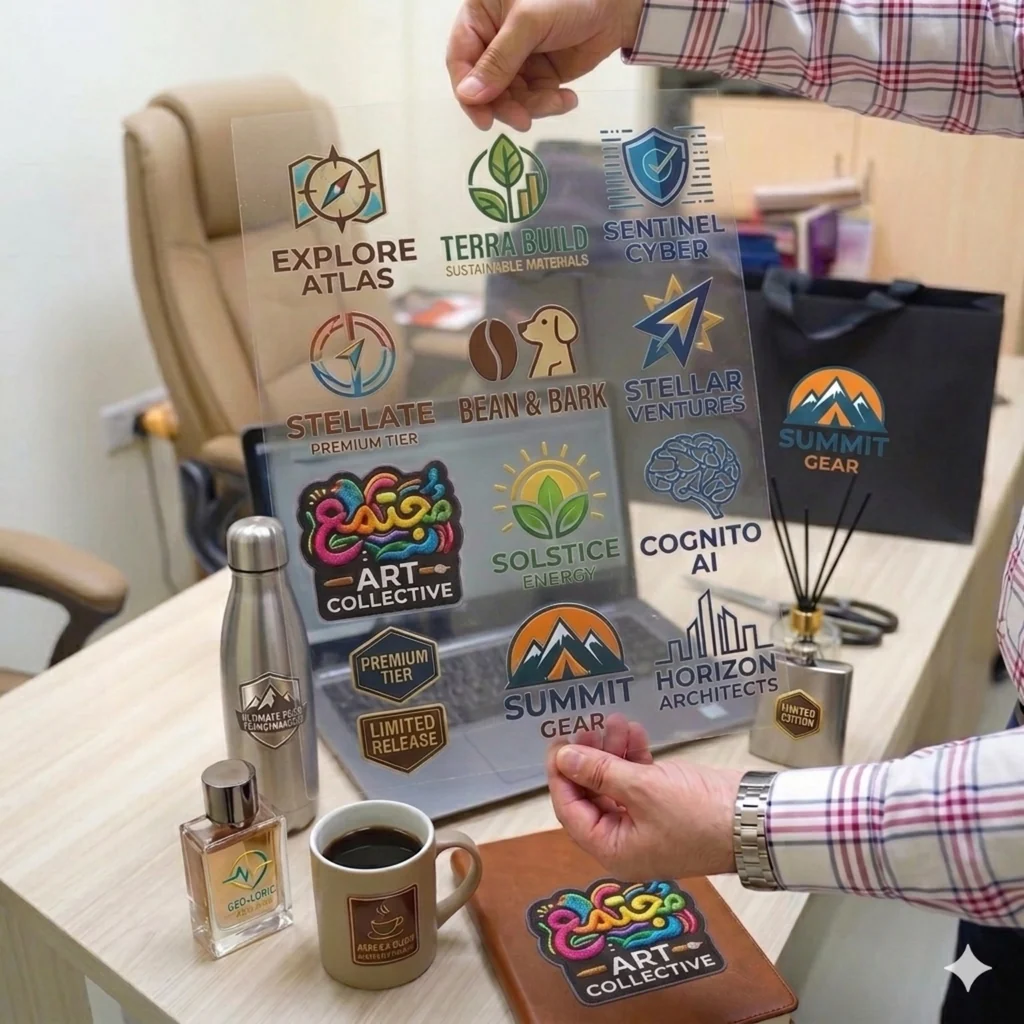
Bring one representative item first
A photograph is useful for discussing placement, but it cannot confirm a surface coating or print adhesion. A metal flask may be bare metal, painted or powder coated. A plastic product may have a soft-touch finish. Those differences matter even when the products look alike.
Send a photo, identify the material and finish if known, and show where the logo should sit. For a batch, confirm that all items are the same model and coating. Agree a sample and a setup allowance before bringing the whole quantity.
Compare the three useful routes
| Method | A useful starting point | What needs checking |
|---|---|---|
| UV DTF transfer | A colour logo transferred onto a suitable hard object surface. | Adhesion to the actual coating, surface texture, application area and expected handling. |
| Direct UV / UV flatbed | Ink printed directly onto a suitable, accessible area of the item. | Flatness, safe holding position, print-head clearance and a successful test print. |
| Laser marking | A mark on a material and coating compatible with the available laser. | The actual metal/coating, the resulting contrast and the approved marking area. |
These are starting points for assessment. A method that works on one bottle or notebook may not work on a different finish.
UV DTF: a colour transfer for suitable object surfaces
The design is printed onto a dedicated film before it is transferred to the item. The transfer route can be useful when printing directly onto the whole object is awkward. It still needs a suitable surface and careful application. A rough, flexible or strongly curved area deserves a sample rather than an assumption.
Ask about the finished feel and the care instructions for that exact transfer and item. A general description such as “UV printed” is not proof that the finished product can go in a dishwasher, be soaked, or tolerate chemicals. Read the UV DTF surface and sample checklist before approving a larger quantity.
Direct UV: the item must be positioned safely
Direct printing needs a stable print area and a safe, repeatable holding position. The material name alone does not settle compatibility: coatings and treatments can change the result. A sample confirms the appearance and adhesion before production.
For Lamasatna’s UV flatbed branding service, you must bring your items. The branding price does not include the blank product or material. Send the item dimensions and the proposed print width × height separately. The item’s overall size and the logo’s size are different measurements.
Laser marking: choose the finish, not a colour-print promise
A compatible laser can create a mark through interaction with the material or its coating. The result depends on both, so request a sample of the finish and contrast. It is a different appearance from laying down a full-colour printed logo; do not select it from a colour mock-up alone.
For laser marking, you must also bring your items. Blank products and material are not included in the marking service. Tell us whether they are bare, painted, coated or otherwise treated. Unknown materials require identification and a compatibility check.
A sensible brief for 100 customer-owned flasks
State that you already have the 100 flasks, give their material and coating, and send a clear side photo. Mark the intended logo position and provide its size in centimetres. Request a small one-sided mark or print area first. Lamasatna does not promise 360° flask engraving or direct printing.
For small curved items, reduce the artwork to its essential details. A stress-ball logo is limited to about 2.5cm maximum and still needs a holding and surface check. A tiny slogan that only reads when enlarged on a screen will be difficult to judge on the finished item.
Keep product supply and branding separate
When comparing quotes, make sure they cover the same thing: branding only, or a product supplied with branding. The customer-owned UV flatbed and laser routes above exclude the blank item. PVC cards have a different choice: tell us whether you need cards supplied or printing on cards you already own, then confirm the applicable current price.
For your UAE enquiry, send the quantity, item photo, material/coating, intended logo size, artwork and delivery city. Approve the sample, price and production scope before treating a preview as an order.
Ask which method suits the items you already own
Technical references
- Mimaki: UV DTF transfer process.
- Roland DG: material, coating, holding and test-print considerations.
- Trotec: matching laser type and material.
Manufacturer references explain general process considerations. They do not confirm a particular customer item or describe Lamasatna’s equipment models.
Sources and references
- mimaki.com/application/solution/uv-dtf_ujv300dtf-75.html · Reviewed 2026-11-04
- lamasatna.com/ask/ · Reviewed 2026-11-04
- downloadcenter.rolanddg.com/contents/manuals/BF-16_USE_EN/ndb1709884557344.html · Reviewed 2026-11-04
- www.troteclaser.com/en/resources/faqs/what-materials-laser · Reviewed 2026-11-04